Brain-Surgery.com
Brain & Neuro Surgery Information Center

Sponsors:


Categories:

 ABCs of Brain Surgery
 Stroke/Brain Attack
 Patient Experience


HISTORY OF BRAIN SURGERY

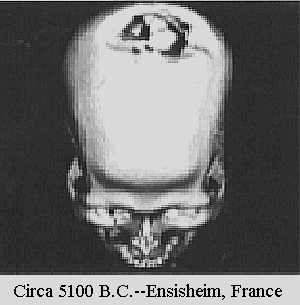
Brain surgery is perhaps the oldest of the practiced medical arts. No hard evidence exists suggesting a beginning to the practice of other facets of medicine such as pharmacology -- using drugs, chemical and natural ingredients to help a fellow human being. There is ample evidence, however, of brain surgery, dating back to the Neolithic (late Stone Age) period. 
Unearthed remains of successful brain operations, as well as surgical implements, were found in France-- at one of Europe's noted archeological digs.

And, the success rate was remarkable, even circa 7,000 B.C.
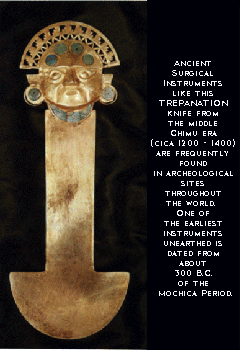
But, pre-historic evidence of brain surgery was not limited to Europe. Pre-Incan civilization used brain surgery as an extensive practice as early as 2,000 B.C. In Paracas, Peru, a desert strip south of Lima, archeologic evidence indicates that brain surgery was used extensively. Here, too, an inordinate success rate was noted as patients were restored to health. The treatment was used for mental illnesses, epilepsy, headaches, organic diseases, osteomylitis, as well as head injuries.

Brain surgery was also used for both spiritual and magical reasons; often, the practice was limited to kings, priests and the nobility.

Surgical tools in South America were made of both bronze and man-shaped obsidian (a hard, sharp-edged volcanic rock).

Africa showed evidence of brain surgery as early as 3,000 B.C. in papyrus writings found in Egypt. "Brain," the actual word itself, is used here for the first time in any language. Egyptian knowledge of anatomy may have been rudimentary, but the ancient civilization did contribute important notations on the nervous system.

Hippocrates, the father of modern medical ethics, left many texts on brain surgery. Born on the Aegean Island of Cos in 470 B.C., Hippocrates was quite familiar with the clinical signs of head injuries. He also described seizures accurately, as well as spasms and classified head contusions, fractures and depressions. Many concepts found in his texts were still in good stead two thousand years after his death in 360 B.C. 

Ancient Rome in the first century A.D. had its brain surgeon star, Aulus Cornelius Celsus. Hippocrates did not operate on depressed skull fractures; Celsus often did. Celsus also described the symptoms of brain injury in great detail.

Asia was home to many talented brain surgeons: Galenus of Pergamon, born in Turkey, and the physicians of Byzance such as Oribasius (4th century) and Paul of Aegina. An Islamic school of brain surgery also flourished from 800 to 1200 A.D., the height of Islamic influence in the world. Abu Bekr Muhammed el Razi, who lived from 852 to 932 in the Common Era, was perhaps the greatest of Islamic brain srugeons. A second Islamic brain surgeon, Abu l'Qluasim Khalaf, lived and practiced in Cordoba, Spain, and was one of the great influences on western brain surgery.

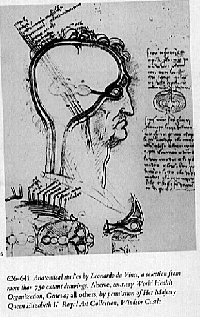
The Christian surgeons of the Middle Ages were clerics, well educated, knowledgeable in Latin, and familiar with the realm of medical literature. Despite the church's ban on study of anatomy, many churchmen of great renown (advisors and confessors to a succession of Popes) were outstanding physicians and surgeons. Leonardo Davinci's portfolio containing hundreds of accurate anatomical sketches indicates the intense intellectual interest in the workings of the human body despite the Church's ban.


Post a Question/Comment:

Title:


work ethic of a bran surgeon (3/10/2010)
work ethic

Topic Continued on Forum...


brain surgery (3/6/2010)
who first performed brain surgery?

Topic Continued on Forum...


brain dissection (3/3/2010)
who did the first brain dissection?

Topic Continued on Forum...


Today's Brain Surgery (2/20/2010)
No, I wouldn't go that far. As one who had brain surgery done at a world famous neurological center, I'd say that it depends pretty much on chance. Sure, the neurosurgeon might be a super-star, the operation could cost a fortune, but does that mean that delving into one's head is a sure answer? Hardly. I had it done, and while it satisfied my curiosity, it certainly didn't do away with my seizures. Oh, I experience fewer of them, and they're less dramatic, but gone? No way. Will historians later in this century stamp such "go-away-epilepsy" jaunts into our head as something short of the answer? Just maybe.

Topic Continued on Forum...


M.Igoe (2/19/2010)
The article above refers to an 'inordinate rate of success'in ancient brain surgery. To make a claim like this, you must have figures and evidence. What was the percentage of success, and who measured the figures? You must have corroborative evidence for a claim like this, as any historian or archaeologist will insist.

Topic Continued on Forum...


Saying 'no' (2/19/2010)
Eleven times now, since a haematoma was found in my right temp lobe, I've been offered brain surgery to remove it. The chance it'll do me any harm: almost none. Chances that it could do harm: dangerously high. It could affect my ability to read and/or speak. It could affect my memory.
But if I have TLE attacks, so what? I don't let them bother me. Why should they? And that's what I can't get the neurologists to understand: I don't want this operation. Why not? My TLE isn't important enough to me. Much worse: I'm a trained linguist and translator, needing to remember thousands of words in five languages, and have used them all for many, many years. So, think what damage loss of memory or use of speech could do. Thanks, but the answer's no, and I've sent it in writing - for the second time, in full detail. I'll try medication changes, certainly, although the medics don't hold out much hope. But put your saw away, Mr Medic. My right temporal stays untouched. I need it for language. Do you imagine people have any more time for people with speech or memory defects than they do for seizures? No, they don't. I'd sooner stay as I am.

Topic Continued on Forum...


M.Igoe (2/19/2010)
Every so often, we get reports of ancient skulls, 6,000 or more years old, with evidence of holes drilled in them (this surgical procedure is still carried out sometimes. It’s usually called trepanning, or possibly ‘trephining’). And you can be almost certain that there will be claims that this is early evidence of epilepsy surgery in ancient times.
Sorry, folks, I don’t want to rain on this particular parade, but it’s no such thing. If you find an ancient pierced skull, it’s evidence of only one thing: that the skull has a hole in it. That’s all. I used to work in archaeology, and came across this sort of thing sometimes. Not nice to look at, but you get used to it. You have to, or you find something else to do.
You can go a little bit further: is the hole regular, say round, in shape or not? If it is, there’s a good chance it was caused by another human. And if it isn’t, possibly it was, more probably it wasn’t. A weapon or a falling stone could easily have the same effect. They’re much more likely.
There’s one very handy way to judge if it was done deliberately: do the edges of the hole show signs of some tool? You can be reasonably sure, if they do, it was deliberate. It could very easily have been a badly-intended weapon, not some prehistoric surgeon. The chances of a weapon of some kind are far higher.
Let’s say it wasn’t a weapon, and that the hole was cut or drilled intentionally. Why would anybody do that to somebody else? Two possibilities: it was to help the person with the drilled skull, or to do him harm. You won’t like this, but here we are: brain material, like bone marrow, is very nutritious. Whoever this was could very possibly, or probably, have been a meal, even a sacrifice. Let’s not pretend: cannibalism is recorded from every period of human history, even into the present. All you need is enough hunger. It was widely reported in the long siege of Stalingrad in the 1940s, for example. If you have people starving, and the dead littering the streets, what do you imagine is going to happen? The survival instinct in us is extremely powerful.
All right, we’ll say the person was being helped somehow. Some people have this done, even now and probably illegally, as some sort of spiritual experience. Or it could be to relieve pressure felt inside the head. That could be a whole range of things, from sinus trouble to migraine.
No, without better evidence, you can’t make any case that this was done to help with epilepsy. Written evidence isn’t available. The earliest writing we know of anywhere dates from just after 2,000 BCE – that’s 2,000 years at least after the date of the drilled skull. This writing comes almost exclusively from the Near and the Middle East, Akkado-Sumerian cuneiform script, which only very few people can read, or early Egyptian hieroglyphs. Ancient Babylon (now Iraq) used cuneiform script too – and this is where we find the first mention of what certainly seems to be epilepsy. It relates it to the Moon-god (called Sin) entering the spirits of people with the condition. It doesn’t mention their heads. Strange, I’ve always thought, that epilepsy is the longest-recorded medical condition we know of, and yet the least-understood by the public, even now. And that makes it a magnet for superstition and quack ‘healers’. The notion still hasn’t died, that it’s some sort of curse or punishment. I’ve heard this said to me, many times. No, I don’t believe that. Why does nobody say the same about flu, for example? But too many people do still think it.
Let’s be honest with ourselves: if we hadn’t been told by someone else, how would we know that epilepsy begins in our heads? We couldn’t possibly know. Instead, we’d still be talking about evil spirits, as some people still do – and they can do a lot of harm (those people, not any spirits).
So, cue the person who first did suspect a physical cause. We don’t know his name, but we call him Hippokrates out of convenience. He lived somewhere in eastern Greece. If he was around now, he’d easily qualify for the Nobel Prize. In a short book (really a long essay), from around 400 BCE – that’s about 200 years after the first use of an alphabet in Europe - he ridicules the name used for epilepsy at the time, The “Sacred Disease”. His book is the first known time that anyone uses in writing the word epilepsy (epilepsia, like in modern Greek today). And, without saying how he worked it out, he hit on the idea that seizures were caused by short-term disturbances of some sort in the brain. The word ‘electricity’, disturbances of which in the brain do cause seizures, didn’t exist until centuries later. Nobody paid much attention, preferring to believe in evil spirits, operating in the soul. It was only in the late1800s, in France, that people realised he had been right all along. That was well over 2,000 years later, long after his death.
So, to get back to the beginning: we find a skull, thousands of years old. It has a hole in it. Guess what, somebody cries out, it’s early surgery, and it must be for epilepsy. Without more evidence than that, and you need plenty, quite literally somebody’s talking out of a hole in the head, not his own but a long-dead someone else’s. A nice idea, I suppose, but there’s no proof –either way. And proof is what you definitely need for a claim like that.

Topic Continued on Forum...


Think It Through: Brain Operation Worthwhile? (2/19/2010)
As a man who chose to have brain surgery done at one of the world's most famous neurological clinics, I offer the above advice. For while many institutions and the surgeons who work therein do point out how many "successful" cases they've had, the definition of "successful" does vary. I, for instance, had been having seizures for over 10 years, had tried over a dozen seizure-control pills, had gotten analyses by four neurologists, and finally began investigating surgery. In my own case, it was determined that a "bruise" was left on both the left and right temporal lobes of my brain because of the use of forcips when I was born. (This is a procedure just not in use anymore.) The side that appeared, via tests, to be worse neurologically was my left. And it was there that I had my 6-hour operation. That was 20 years ago, and while my use of more recently-introduced drugs has helped, my expensive surgery in no way "cured me" of seizures. They're still there, a bit milder, and now occur mainly when I first awaken in the morning. I would suggest that anyone investigating brain surgery should get opinions from not only two or three neurosurgeons, but from folks like myself.

Topic Continued on Forum...


college degree (2/16/2010)
what is the degree you have to get and what are the degrees

Topic Continued on Forum...


what does phineas gage have to do with the history of brain surgery? (1/21/2010)
phineas was a really interesting case and i believe that it deserves a part in this text, keeping in mind that gage surgery was one the most popular because of his rehabilitation...

Topic Continued on Forum...


© Copyright 2010 Brain-Surgery.com - Contact Us